Dr. Ambedkar’s editorial on Bhagat Singh-Rajguru-Sukhdev execution on 13th April 1931
- Post author
· By Prof. Chaman.JNU
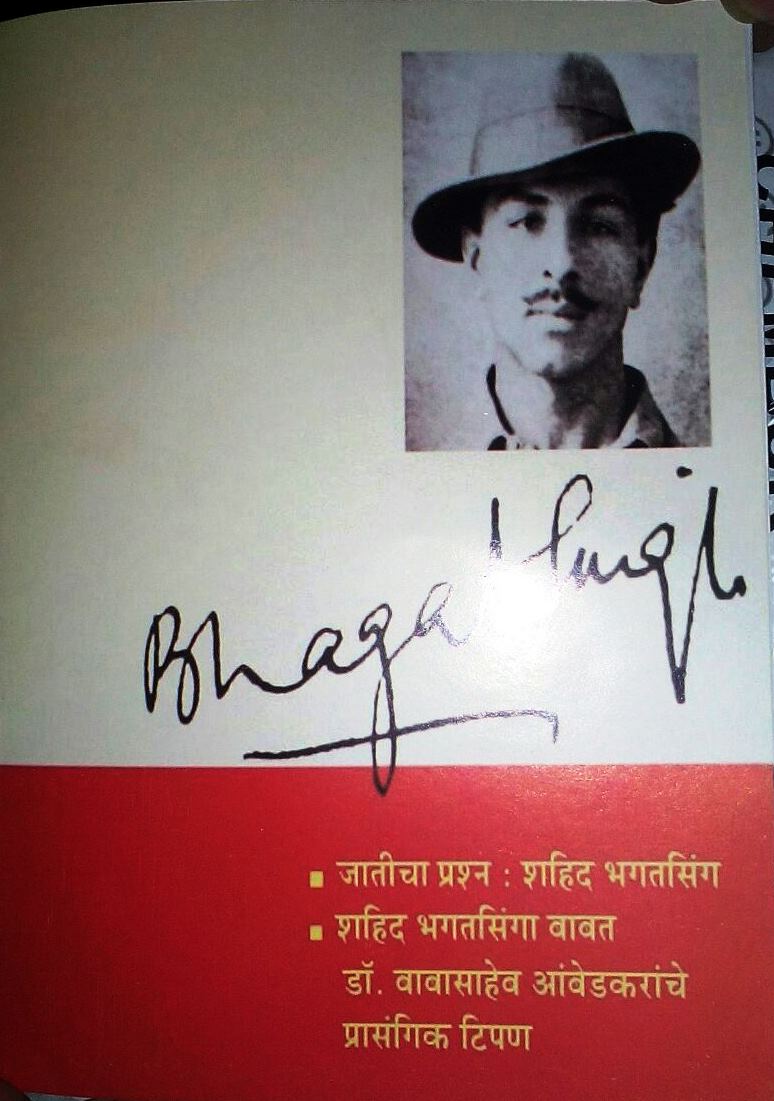
I was searching for Dr. Ambedkar’s writings on Bhagat Singh, since 2006, when I suddenly recovered Periyar’s editorial on Bhagat Singh in 29th March 1931 issue of his Tamil weekly-‘Kudai Arsu’, while visiting Periyar Tiddle in Chennai. The editorial was translated into English after 75 years of its first publication in Tamil at my request and was published in October 2006 issue of ‘The Rationalist’, which has been included in my two books-Jail Notebook and Other writings of Bhagat Singh and Understadnign Bhagat Singh.
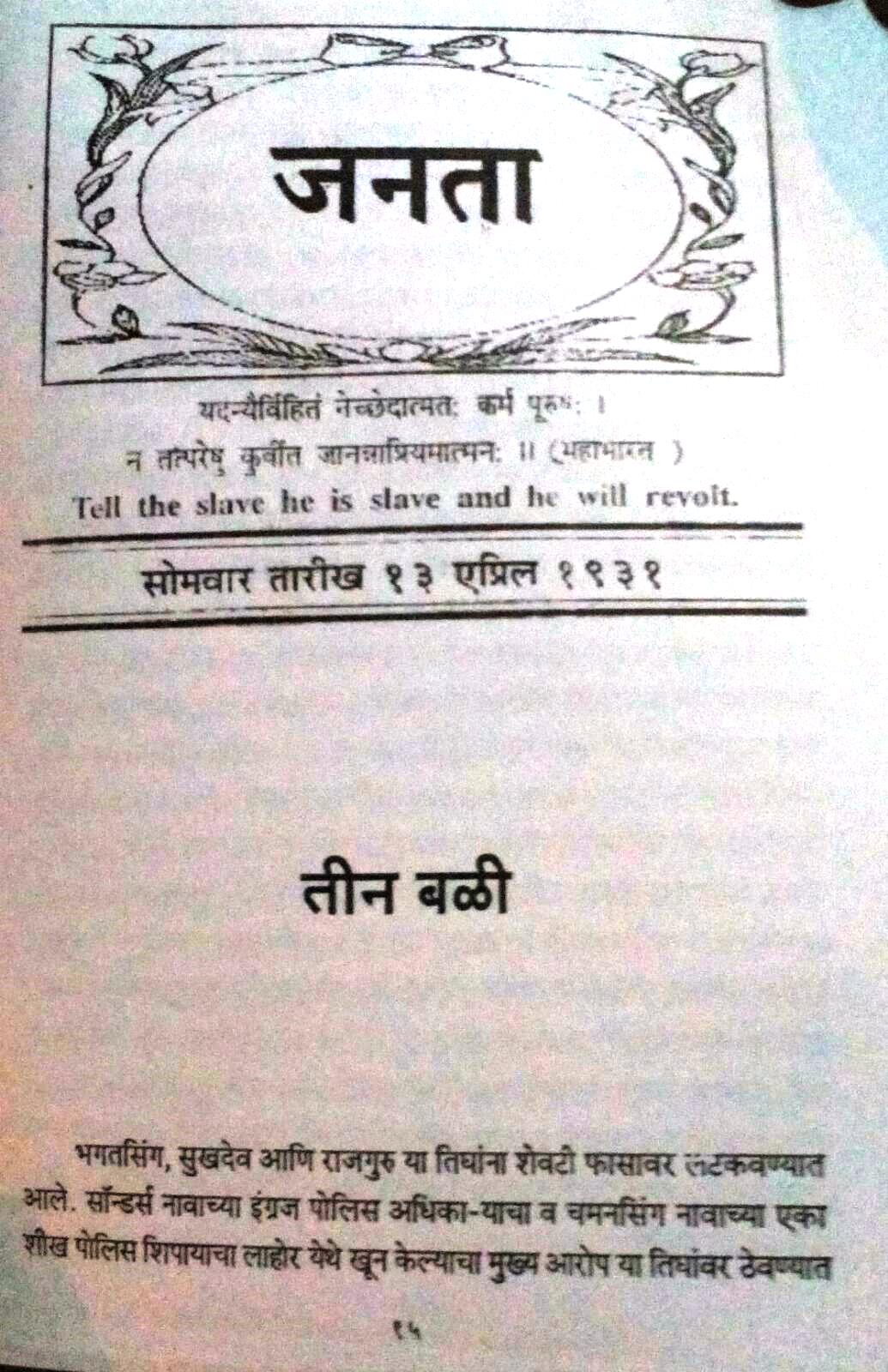
On 30th January this year I met Subodh More, grand son of historic 1927 Mahad movement account writer R B More, who informed about ‘Janta’ editorial of Dr. Ambedkar in 1931. He was kind enough to send me the copy of it, which I requested Anand Teltumbde to translate in English and Subhas Gatade in Hindi. Both have been kind enough to provide me English and Hindi translation of the editorial, which is being shared here in both the languages, thanks to Subodh Moe, Anand Teltumbde and Subhas Gatade.
Three Sacrifices -Dr. Ambedkar editorial on Bhagat Singh execution
(Janata dated 13 April 1931)
Bhagat Singh, Sukhdev and Rajguru have been eventually hanged. They were charged for the murders of an English police officer named Sanders and a Sikh police sepoy named Chaman Singh. Also there were three or four additional charges such as an attempt of murdering one police inspector at Banaras, throwing a bomb in the Assembly, conducting robbery at a house in Maulimiya village and looting its valuables. Bhagat singh had already admitted to the charges of throwing bomb in the Assembly. For this crime, he and Batukeshwar Dutt were already sentenced with life imprisonment. One of the comrades of Bhagat singh by name Jaigopal had confessed that the murder of sanders was executed by them revolutionaries including Bhaga tsingh and others. The government had filed a case against Bhagat singh and his comrades based on this confession. None of the three accused participated in this case, however. A special tribunal comprising three high court judges was appointed which heard the case and unanimously awarded them death penalty.
Bhaga tsingh’s father had made a mercy petition to the Emperor and the Viceroy requesting them not to execute the punishment and convert if required into life imprisonment at Andamans. Many people including prominent leaders also tried to plead with the government in the matter. The issue of Bhaga tsingh’s death penalty might have arisen in negotiations that took place between Gandhi and Lord Irwin. Although Lord Irwin had not given any definitive assurance about saving Bhaga tsingh’s life, Gandhi’s speech during the intervening period created a hope that Irwin would try his best within his powers to save lives of these three youth. But all these hopes, predictions and appeals proved futile. They were killed by hanging in the Central Prison, Lahore on 23 March 1931 at 7 pm. None of them had made any appeal for saving them. But as it is already published, Bhaga tsingh had expressed a desire for being killed with bullet shots instead of hanging by the neck. But even this last will of his was not granted and they implemented the judgment of the tribunal verbatim. The judgement was to hang by the neck till dead. If they were killed with bullet shots, the execution would not confirm to the judgement verbatim. The order of the justice goddess was obeyed in toto and the three were killed with the method she prescribed.
For whom the Sacrifice?
If the government thinks that people would be impressed by its display of devotion to and strict obedience of the justice goddess and therefore they would approve of this killing, it would be its utter naiveté. None believes that this sacrifice was made with only intention of maintaining clean and sans blemish reputation of the British justice system. Even the government will not be able to convince itself with such an understanding. Then how will it convince others with this veil of the justice goddess? The entire world, as well as the government does, knows that it is not the devotion to justice goddess but the fear of the conservative party and public opinion back home in England that this sacrifice was executed. They thought, the unconditional release of political prisoners like Gandhi and signing pacts with Gandhi’s party has damaged the prestige of the Empire. Some orthodox leaders of the conservative party have launched a campaign that the prevailing cabinet of the Labour Party and the Viceroy who danced to its tune were responsible for it. In such a situation if Lord Irwin had showed mercy to political revolutionaries who have been convicted for assassinating an English officer, it would be like giving a burning torch into the hands of the opposition leaders. Already the condition of the Labour Party is not stable. In such a situation if these conservative leaders got an alibi that the labour government grants clemency to the convicts, who had murdered an Englishman, it would be so easy to provoke public opinion against it. In order to avert this imminent crisis and to thwart the fire in the minds of conservative leaders from flaring further, these hangings were executed.
As such this was not to satisfy the justice goddess but to please public opinion in England. If it had been the issue of personal liking or disliking of Lord Irwin, he would have within his own powers annulled the death penalty and awarded life imprisonment in its stead. The cabinet of the Labour Party in England would have supported Lord Irwin in this decision. It would have been necessary to maintain congeniality of public opinion in the context of Gandhi-Irwin pact. While leaving the country, Lord Irwin would surely have liked to earn this goodwill. But he would have been crushed between the ire of his conservative kin in England and the Indian bureaucracy imbued with the same casteist attitude. Therefore, not minding the public opinion here the government of Lord Irwin hanged Bhagat singh and his comrades to death and that too just 2 to 4 days before the Karachi conference of the Congress. Both, the hanging of Bhagat singh and his comrades, and its timings, were sufficient to puncture the Gandhi-Irwin Pact and to trash the efforts to bring it about. If Lord Irwin wanted to fail this pact, he would not have found better act than this one. Looking from this perspective, as Gandhiji also felt, one could say that the government committed a great blunder.
In sum, merely not to incur anger of the conservatives in England, they sacrificed Bhaga tsingh and his comrades ignoring public opinion and not minding what would happen to the Gandhi-Irwin pact. The government must remember, howsoever it tries to cover it up or polish it; it will never be able to hide this fact.
Dr Anand Teltumbde is a writer, political analyst and an activist with CPDR, Mumbai


