Along with broader movement against the authoritarian project of RSS and BJP, emphasis must be laid on politicisation of society and balance of social forces must be changed
https://countercurrents.org/2020/09/how-to-counter-the-hindutva-project/
Recently, senior journalist Santosh Bhartiya interviewed me on the contradictions of left movement. Responding to his question, I said that for me left movement in India is a democratic movement which stands for democratisation of state and society. I also said that call it irony of history or tragedy that the three major streams of democratic movement could not evolve mutual political understanding for a broad political coalition. Coming together on a common political platform of CPI formed in 1920, CSP (Congress Socialist Party) led by Acharya Narendra Dev, also based on Marxist philosophy and Independent Labour Party like streams formed by Dr Ambedkar was very much needed. At least after independence, in my view, it was primarily responsibility of the Communist Party to form such a political platform as it was strongest in terms of mass base and organisation, compared to other democratic formations.
I also said that to portray Gandhi as a revivalist against modernity or he was opposed to land reforms is not true as objective reading of history. We must understand that the ideas of Gandhi were continuously evolving. The ideas which Gandhi expressed in Hind Swaraj in 1909 had changed a lot by 1948. In his talk with Louis Fischer, an American journalist in 1942, Gandhi said that peasantry will take the land of landlords. When he asked regarding paying compensation, he replied, how that can be given. When Fischer asked him regarding violence in 1942 Quit India movement, Gandhi didn’t answer. He was very clear about the form of struggle. While accepting his differences with Subhash Chandra Bose, he regarded him as the greatest one among all patriots. In fact, the first and foremost agenda before Gandhi ji was how to liberate the country. He wanted ouster to British ruling class at any cost. He even said that let them go and even if it means anarchy for some time, we are ready for that. Gandhi very well understood the divisive politics of British colonialism. He laid maximum emphasis on Hindu-Muslim unity. He made all efforts to avoid partition till end. After partition, he advocated brotherly relations with Pakistan. It was his earnest desire that there should be a relationship between India and Pakistan like two civilised nations. His vision was clear regarding religion too. The religion which he advocated was universal moral values. So far as practicing religion like Hindu, Muslim, Sikh, Christian and Parsi were concerned, he regarded these religions as a matter of personal faith and belief. By all these I mean to say is that Gandhi ji’s vision about independent India was in many ways similar to Dr. Ambedkar’s “The State and Minorities” as well as programmes of the Communist and Socialist parties.
Although there are no ifs and buts in history, still, if we want to discuss formation of a broader political platform against the challenge posed by RSS and BJP which is being actively supported by finance capital, we have to evaluate the history. As there was very favourable and to some extend dominance of socialist ideas during freedom struggle and afterwards, I believe that there was an underestimation of the inherent potential of development of productive forces in capitalism. Communist movement though accepted democratic revolution as a necessary stage before socialism but for the life of this interim period, there was no clarity about this as it was thought a short lived phase of development. That is why there is less emphasis on developing organisation, policy, politics and slogans suited to that political juncture. Instead of giving much emphasis to socialism the time was to discuss alternative democratic model of capitalism based on peasant path of development.
Anyway, the forces of democratic movement remained scattered and could not develop an effective opposition, as a result Congress got free hand to rule the country. In these circumstances, Congress Party which was supposed to carry forward India could not play the desired role. The provincial Congress governments formed during 1937 to 1939 period were anti-people, corrupt and communal. Pandit Nehru became PM and he played an important role in the modernisation of India but the umbrella like form of Congress and it’s capability to accommodate various progressive ideologies gradually collapsed and there emerged a rightist consolidation within Congress. Pt. Nehru failed to resolve the vital issues like communalism, border dispute and democracy. Within Congress, there was always a tendency of Hindu preference and gradually, it has been retreating from fundamental change in society. So, despite accepting Nehru’s role in modernisation of India, we must keep in mind what Acharya Narendra Dev founder of CSP had said that Congress was not ready for fundamental and basic changes.
During Indira Gandhi’s rule, Hindu preference was gradually replaced by Hindu supremacy and in 80s Congress was openly complicit with the Hindutva politics of RSS and BJP. During Narasimha Rao government, the anti-people, communal and corrupt face of Congress was thoroughly exposed. The role of the central government in Babri Mosque demolition also became explicit. Before this, Congress was already badly exposed in anti-Sikh massacre 1984. This government had a big role in the horse trading of parliamentarians, ever-increasing corruption and degeneration of parliamentary politics. Also during this regime, Nehruvian mixed economy was rejected as quota-permit raj and the government completely surrendered before neo-liberal economy. Till today all sections of the society are suffering from its ill-effects and now people have started raising voice against it in various forms. The direction of these movements is against corporate and finance capital.
Broadly speaking in 2004, Manmohan-led UPA government proved to be a government which continued old policies of Congress in other forms instead of being a government of secular values and welfare policies. It further advanced the pro-American foreign policy, intensified privatisation under liberalisation, enacted UAPA like draconian act, and continued repression over all sections of the people. Its alliance with left front for some years was sidelined. Manmohan government was thoroughly defamed for corruption and it paved the way for the formation of BJP alliance led government. After set back in the front experiment with Congress, Left Front has withdrawn for the time being from political front formation at national level with the Congress or regional parties.
Regarding national freedom movement, I want to point out on one issue that sufficient attention was not paid to the danger posed by Hindutva thinker and political activist Vinayak Damodar Savarkar and RSS ideologue Golwalkar who played sub subservient role to British imperialism against national movement. Their ideology was committed to disenfranchise a large population in the name of Father-Land and Holy-Land. In its pursuance, Modi government has enacted CAA. Despite being fully aware about the dangers of majoritarianism, Pt. Nehru appointed Shyama Prasad Mukherjee as the Cabinet Minister in his Interim government. It was Shyama Prasad Mukherjee who after resigning from Nehru cabinet joined hands with RSS to form Jan Sangh. Now, someone justifying Nahru may say that it was done under pressure of the then prevailing conditions. But, mistake will remain a mistake. After independence, political experiments of Dr. Lohia and JP to combat Congress made cause with the Jan Sangh providing legitimacy to the politics of RSS. Whichever government was there, since supporting VP Singh government in the 90s up to 2014, BJP and Sangh kept deepening their roots in the society.
Regarding Anna movement and AAP leadership, Prashant Bhushan’s acceptance with regret that RSS and BJP played role in propping up the movement, is very important and a lesson for others that one must understand RSS-BJP tactics to infiltrate various movements for their own cause to disrupt the movement. Today, people’s discontent against Modi government is rising and RSS people will try to infiltrate into anti-government agitations in various forms as they once did by forming Swadeshi Jagran Manch and later joining Anna movement.
So far as Communist movement is concerned, debates regarding characterization of state, united front and parliamentary democracy still remain. In the 90s, instead of developing left-democratic confederation incorporating different levels of democratic forces and the movements, the experiment of mainstream Left to form National Front with regional parties and run the government, failed both at policy level as well as at the level of practical politics. It failed to check the rise of the BJP.
RSS has still not succeeded in forging pan Hindu unity, but the illusion of Mandal politics in combating BJP is completely shattered. Modi government is now speedily implementing Hindutva agenda which Sangh could not get implemented during Atal government. After defeat of Atal government in 2004, Advani went ahead with a so called liberal face knowing the limits of sectarian politics in electoral arena. For this purpose he utilised occasion of his Pakistan visit and declared there Jinnah to be secular which was contrary to Sangh thinking. Here, he made mistake in understanding RSS mood and motion of finance capital. He lost BJP leadership in the same manner as he had once captured it on Ram temple issue from Atal Bihari Vajpayee’s so called Gandhian socialism.
Modi government is a government of Hindutva and Corporate nexus. To divert attention from the primitive accumulation through loot of minerals and natural resources, Manmohan- Chidambaram government termed Maoism as biggest threat to internal security of India. In Modi government, so called Islamic terrorism is also added to it. In fact, RSS has already been describing Islam, Christianity and Communists as its three big enemies in the country. For finance capital, welfare state is a danger, so liberalism is also target of this nexus. Finance capital is dangerous for environment and nature on the one hand, while on the other hand it has broken the backbone of workers, peasants, and trade, small and medium enterprises. Under black laws, Sangh is sending its ideological-political opponents to jails, declaring them anti-national. Modi government is running this organised campaign of loot and repression. Repression is increasing on Dalits, Adivasis, minorities and women. Modi government has extremely weakened all democratic institutions from within and it is working overtime to convert them into authoritarian institutions. Even changing the character of the bill, passing bills by all sorts of manipulations, coercion, misuse of higher positions of the parliament has become hall mark of Modi regime. In fact, democratic institutions are being given authoritarian shape. So called liberals occupying higher positions in the parliament are getting exposed and a new phase of the degeneration of parliamentary politics in naked form is coming to the fore. Executive and bureaucracy, still broadly run with British laws, remain institutions of repression. Rejecting administrative autonomy, which was recognized till date, some bureaucrats in higher position are now functioning as RSS and BJP cadres. Many outgoing administrative and military officers are conducting campaign against democracy; they are busy competing in jingoist propaganda at various channels. War-mongering has become synonym to patriotism for them.
Judiciary, particularly Supreme Court (SC), which owes responsibility to safeguard democracy and Constitution, has compromised with government in many of its misdeeds. Two years back, press conference by sitting SC judges is proof enough of the fact how democracy is being throttled in SC. Now, it has become crime to express opinion about courts. Anyway, this institution is vitally important in defending Constitution and parliamentary democracy, hence battle for its democratisation and making its functioning transparent is very much necessary.
In totality, one can say that India is passing through a phase of an unprecedented challenge where there is danger, not only for Indian Constitution and democracy but also for Indian culture and civilisation. Politics of opposition against Modi government has become visionless and compromising. Congress and regional parties have compromised with majoritarianism and finance capital. Character of their governments, too, is undemocratic and autocratic. There seems to be no policy difference with Modi government and their politics. So, one shouldn’t harbour any illusion regarding their role for protection and extension of pro-people policies and democratic rights. Their role comes into display in symbolic political protests inside as well as outside parliament and in elections against BJP alliance. In this situation, it is imperative to think over the immediate and long-term role of alternative politics, politics of alternative or which I call people’s politics.
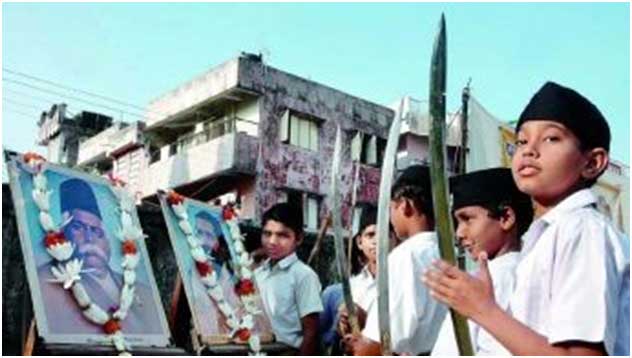
Today, we are fighting against such a philosophy, ideology and politics, whose lumpen army terms Gandhiji’s assassination as a slaughter of Gandhi! The author of “I am a troll” says that PM poses for photographs with his trolls army and encourages them. Modi government’s minister garlands lynch mob criminals. Even earlier RSS used to organise group worship of arms. So, today’s political situation can’t be compared with Emergency that was a black chapter of parliamentary politics, a horrifying event. But, behind today’s repression are the Hindutva philosophy and the idea of an authoritarian political system which doesn’t even believe in Indian Constitution and parliamentary democracy.
Today, we have entered in a phase of finance capital hegemony world over. In India, finance capital firmly stands with Hindutva politics. People know about the large sums of one-sided donations given to BJP by domestic and foreign corporations through electoral bonds. RSS and BJP have maintained their hold over the social structure. But, here, all contradictions of society are sharpening under Modi regime. The protests visible so far in the civil society movement, are now spread to peasantry, workers and youth movement. In coming days, all these movements will be further intensified, so these movements should not be left in spontaneity, but must be channelized towards systematic people’s politics. Defeating the politics of RSS and BJP and defeating BJP alliance in elections must become national task. This national task does not prohibit Left and democratic forces from independent participation in elections.
We must discuss some political realities of this phase. It is true that movements are rising against Modi government. Civil, social and Ambedkarite Dalit movements are forcefully opposing repression but these streams have no political presence. At this juncture, these movements must redefine themselves and accept the challenge facing the country. The forces of alternative politics associated with the ideas of Gandhi, Lohia and JP should also think over their political orientation. I mean regarding the mainstream Left, it is true that Left Front governments did compromise with finance capital in the name of developing productive forces and suppressed the voices of protest. But, one must make distinction between party and its government and Left parties, so far, have not accepted neo-liberal economy. Left movement is integral part of democratic movement and it has got political presence. It is also true that main streams of left movement don’t take interest in the formation of Left-Democratic Front. But, they take part in class-sectional movements on democratic issues, be it peasant, youth or working class movements. They are interested in environmental movement, too. There is a need of political dialogue with them because they have a committed history of battle against RSS and BJP. If all these streams come together on a political platform, which I call multiclass party, then a formidable resistance force may emerge against authoritarianism in Indian politics. Here, I don’t agree with those who think that this task is impossible and terming politics as the art of possible, advocate politics of manipulation. In such a platform, all democratic, Left groups, individuals, movements, people from oppressed caste, communities and victims of regional imbalance may join. Organic relations will develop among them; this may become an effective political platform. Pre-independence Congress, Chinese Kuomintang party, African National Congress have been witness to such experiments.
This people’s politics must compete with the ruling class’s politics and participate in day to day political activities. At any cost, its independent political position should not be diluted. After formulation of political programme, organisation building must be accorded top priority. Masses must be educated about the character of state structure working in a particular class interest. One must integrate with the masses. Despite accepting the importance of propaganda network, it is clear that twitter, facebook, whatsapp and courts will not decide the course of history. People and its class conscious party are the only decisive element of the history and we have to strengthen that.
In my view, today’s main problem is not that we did not associate with our tradition, culture and language. All Congress stalwarts including Gandhi ji, despite close links with their tradition, language, religion and culture, could not stop partition of India. It is also noteworthy that leaders of all parties are not elites. Common masses have no problem in understanding their language and style; still they are failing to stop the authoritarian politics. So if the basic spirit of social, economic, political justice enshrined in our Constitution, couldn’t become the spirit of common masses, then we must think over the character and form of politics and organisation. If the battle for casteless, classless, secular, civil society became weak and Hindutva politics became strong, then we must ponder over our weaknesses in battle against casteist, bourgeois landlord state. Why the ideological hegemony of rationality and morality could not be established in Indian society needs a serious review of politics and organisation. While fighting for citizenship, we must fight against war-mongering because battle for citizenship is integrally linked with anti-imperialist nationalism. Instead of equi-distance, we should openly speak against American ruling clique; resolve our inherited border disputes through talks and negotiations. Some socialist and peace-loving people have coined apt slogan “We want Buddha, not Yuddha (war)” We firmly believe that the forces of authoritarianism will be defeated and the people’s politics will be victorious.
Akhilendra Pratap Singh, Swaraj Abhiyan


