This blog has been created to bring before the readers the true picture of Dalit Liberation Movement (political,social,religious,economic and cultural) as prevailing in India today. We also aim to project the true philosophy of Dr. B.R.Ambedkar, the true liberator of Dalits(Untouchables) of India.
Sunday, 27 November 2022
Why does BJP oppose the word secular?
Monday, 11 April 2022
Attempts by RSS to present Ambedkar as a Hindutva supporter
- S R Darapuri,
National President, All India People's Front
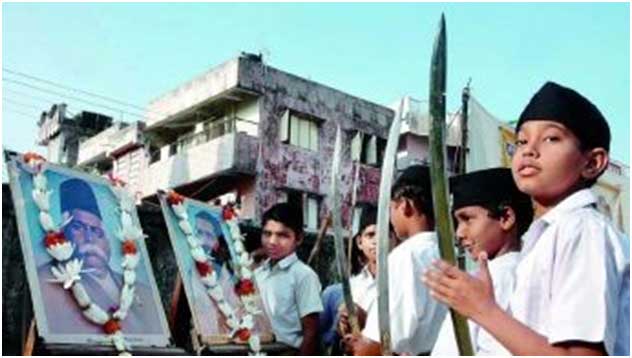
According to a newspaper, this time the RSS is going to do a big program to connect the Dalits. According to this, for the first time on Ambedkar Jayanti, flowers will be offered on photographs in branches across the country. On Ambedkar Jayanti i.e., on April 14, especially those statements of Dr. Bhimrao Ambedkar in which Hindutva is strengthened with patriotism, will be told in the branches. Sangh will explain Ambedkar's Hindutva in 11 points.
Therefore, it is necessary to analyse the right or
wrong of the views/points being propagated/disseminated by the Sangh. From this
point of view, it is necessary to comment on the 11 points chosen by the Sangh to explain Ambedkar's Hindutva, which is as
follows:
1. In his book “Thoughts on Pakistan”, Ambedkar criticized the Congress for being pro-Muslim regarding the partition on religious lines.
Comment: This statement is wrong. Ambedkar, in the referenced book, instead of the Congress being pro-Muslim, has spoken of alienating the Muslim League in the first election by not giving the power share as promised before the election and forming the government alone, as a result the distance and mistrust grew in Congress and the Muslim League and it started moving strongly towards the demand for Pakistan.
2. He was a strong supporter of the Uniform Civil Code. He had clarified that I do not understand why there is so much opposition to the Uniform Civil Code.
Comment: It is true that Dr. Ambedkar was in favour of the Uniform Civil Code but due to widespread opposition to it, he could not do anything about it. At that time there was a general opinion that instead of coercion, consensus should be made whenever possible. Will the RSS also tell how strongly they and the Hindu Mahasabha opposed the bill when Dr. Ambedkar brought the Hindu Code Bill to empower Hindu women? They had called Dr. Ambedkar anti-Hindu and untouchable as a breaker of Hindu families and he was even threatened with death. In the Constituent Assembly, the President of the Assembly Dr. Rajendra Prasad and the Hindu members of the Congress did not pass it due to widespread opposition and the imminent election of 1952, on which Dr. Ambedkar resigned from the post of Law Minister. Is there any such instance in the country when a minister has resigned for women's rights? The RSS should not forget the history of its protest and talk about the opposition of Muslims only. An effort should be made to reach a broad consensus in this regard. Muslim society should also think about this with an open mind.
3. He strongly opposed Article 370 in Jammu and Kashmir. In the concept of nationalism, he was in favour of monolithic nationalism.
Comment: It is true that Dr. Ambedkar was not in favour of Article 370 in Jammu and Kashmir. Therefore, he did not draft this article in the Constitution. But Dr. Ambedkar was not in favour of Hindu monolithic nationalism but was against the partition of India. He was of the firm opinion that we should try and make a serious effort to persuade the Muslim League to give up the demand for Pakistan out of fear of discrimination against Muslims in independent India. Today the policy of discrimination and oppression that RSS is adopting towards Muslims/Christians and other minorities is right for the unity and integrity of the country?
4. Always supported the concept of nationalism, he has written in section-5 of Sampoorna Vangmay that I will live and die for India.
Comment: Dr. Ambedkar never supported the RSS brand Hindu nationalism. His nationalism was based on the concept of liberty, equality and fraternity of all citizens but the ideology of RSS is quite the opposite. He was against nationalism based on any kind of racial and religious discrimination. He had said, “Some people say that they are Hindu, Muslim or Sikh first and then Indian. But I am an Indian from beginning to end."
5. Speaking in the Constituent Assembly on 25 November 1949, Dr. Ambedkar strongly opposed the leftist ideology.
Comment: This statement is absolutely false. He did not oppose the Left anywhere in his speech. In his speech, he opposed all forms of dictatorship, even if it was the dictatorship of the proletariat. Dr. Ambedkar was a socialist in his political thought. Dr. Ambedkar was actually a Liberal Democrat. He was a strong supporter of State Socialism. The biggest example of his favouring state socialism is found in the draft of his own constitution which is printed in the form of "State and Minorities" booklet. In this he had demanded the nationalization of all agricultural land and collective farming on it. Apart from this, he was also in favour of the nationalization of insurance and compulsory insurance for all citizens, whereas today the RSS-run BJP government is engaged in the privatization of all this.
6. Dr. Bhimrao Ambedkar had similar views on a secular nation as RSS.
Comment: Dr. Ambedkar was not in favour of a sectarian but a secular nation. Dr. Ambedkar was opposed to the entry of religion into politics. He considered religion to be a private belief and was in favour of keeping it away from the affairs of the state. The RSS wants to justify its politics of Hindutva and the establishment of a Hindu Rashtra by describing Dr. Ambedkar as a supporter of a sectarian nation.
7. Strongly supporting Hindu unity, Baba Saheb has written in his biography that between me and Savarkar there is not only a consensus but also cooperation. Hindu society should be united and organized.
Comment: This statement is absolutely false. Babasaheb has not written like this anywhere in his biography. This confusion is being created by misrepresenting the letter written by Babasaheb in reply to the invitation letter of Savarkar. Hence the letter is being presented completely so that the readers can come to know about the intellectual dishonesty of Savarkarites. It read: "Many thanks for your letter inviting me to open a temple at Ratnagiri Fort for the untouchables. I am very sorry that due to a prior engagement, I am unable to accept your invitation. I, however, would like to apprise you on this occasion to appreciate the work you are doing in the field of social reforms. When I look at the problem of untouchables, I think it is deeply related to the question of reorganization of Hindu society. If untouchables are to be a part of Hindu society, it is not enough to remove untouchability, for that you have to destroy Chaturvarnya. If they are not to be an integral part, if they are to be only an appendix of Hindu society, so as far as the temple is concerned, untouchability will remain. I am glad to see that you are among the very few who have felt it. That you still use Chaturvarnya's jargon, unfortunately however you say it lets justify on merit, However, I do hope that over time you will be able to remove this unnecessary and it is clear that in this letter, Dr. Ambedkar expresses the possibility of untouchables to be included in Hindu society only after the elimination of Chaturvarna, whereas Savarkar talks of temple entry only to end untouchability. It is clear from this that there is a vast difference in the approach and strategy of both regarding the untouchable problem.
8. On the issue of eradicating caste discrimination, the views of the Sangh and Ambedkar are completely identical.
Comments: This statement is absolutely wrong as Sangh and Ambedkar have completely different views on the issue of eradicating caste discrimination. Babasaheb was in favour of caste annihilation whereas the Sangh is in favour of caste harmony (as the status quo) and not the destruction of castes. Sangh considers Manusmriti as the holy book of Hindus whereas Babasaheb considered it to be a very anti-Dalit book. That's why he also did a public burning of it on December 25, 1927. Sangh is wholeheartedly engaged in the establishment of Hindu Rashtra through Hindutva (Hindu political ideology) while maintaining the caste system whereas Babasaheb was staunchly opposed to the establishment of Hindu Rashtra. In fact, Dr. Ambedkar came to the conclusion in 1940 that "if Hindu Raj becomes a reality, it will undoubtedly be the greatest calamity for this country... [it] will be a threat for liberty, equality and fraternity. Accordingly, it is incompatible with democracy. Hindu Raj should be stopped at any cost."
9. Baba Saheb had full faith in Indian culture.
Comment: There is no doubt that Babasaheb had full faith in Indian culture but that culture is totally different from the culture defined by RSS. RSS defines Indian culture as Hindu culture whereas Indian culture is a mixture of different cultures. In this, there is a set of cultures like Hindu, Buddhist, Jain, Sikh, Christian, Parsi etc. RSS considers Hindu culture to be superior to other cultures.
10. Baba Saheb always considered Islam and Christianity as foreign religions.
Comment: It is true that Babasaheb considered Islam and Christianity as foreign religions but he never looked down upon these religions. It is a different matter that he criticized the evils prevalent in these religions in India like caste discrimination etc., considered it a contagion of Hinduism and also asked them to reform those religions according to their original spirit. Even in adopting Buddhism, he had kept the national interest above.
11.
Babasaheb was unanimous on the Aryans being of Indian origin.
Comment: It is true that Babasaheb has said in the book " Who were Shudras and How" that the Aryans were of Indian origin. His study was based on the information available up to that time. But after this, the study of DNA of different races has found that the DNA of the Aryan race is similar to that of Iran and other European races which definitely came from Central Asia.
It is clear from the above analysis that the intellectual program run by the RSS from April 14 is an attempt to present Dr. Ambedkar's ideas in a wrong way by showing them in their favour, while there is a world of difference between the ideology of Dr. Ambedkar and the Sangh.Monday, 28 September 2020
How To Counter The Hindutva Project?

Along with broader movement against the authoritarian project of RSS and BJP, emphasis must be laid on politicisation of society and balance of social forces must be changed
https://countercurrents.org/2020/09/how-to-counter-the-hindutva-project/
Recently, senior journalist Santosh Bhartiya interviewed me on the contradictions of left movement. Responding to his question, I said that for me left movement in India is a democratic movement which stands for democratisation of state and society. I also said that call it irony of history or tragedy that the three major streams of democratic movement could not evolve mutual political understanding for a broad political coalition. Coming together on a common political platform of CPI formed in 1920, CSP (Congress Socialist Party) led by Acharya Narendra Dev, also based on Marxist philosophy and Independent Labour Party like streams formed by Dr Ambedkar was very much needed. At least after independence, in my view, it was primarily responsibility of the Communist Party to form such a political platform as it was strongest in terms of mass base and organisation, compared to other democratic formations.
I also said that to portray Gandhi as a revivalist against modernity or he was opposed to land reforms is not true as objective reading of history. We must understand that the ideas of Gandhi were continuously evolving. The ideas which Gandhi expressed in Hind Swaraj in 1909 had changed a lot by 1948. In his talk with Louis Fischer, an American journalist in 1942, Gandhi said that peasantry will take the land of landlords. When he asked regarding paying compensation, he replied, how that can be given. When Fischer asked him regarding violence in 1942 Quit India movement, Gandhi didn’t answer. He was very clear about the form of struggle. While accepting his differences with Subhash Chandra Bose, he regarded him as the greatest one among all patriots. In fact, the first and foremost agenda before Gandhi ji was how to liberate the country. He wanted ouster to British ruling class at any cost. He even said that let them go and even if it means anarchy for some time, we are ready for that. Gandhi very well understood the divisive politics of British colonialism. He laid maximum emphasis on Hindu-Muslim unity. He made all efforts to avoid partition till end. After partition, he advocated brotherly relations with Pakistan. It was his earnest desire that there should be a relationship between India and Pakistan like two civilised nations. His vision was clear regarding religion too. The religion which he advocated was universal moral values. So far as practicing religion like Hindu, Muslim, Sikh, Christian and Parsi were concerned, he regarded these religions as a matter of personal faith and belief. By all these I mean to say is that Gandhi ji’s vision about independent India was in many ways similar to Dr. Ambedkar’s “The State and Minorities” as well as programmes of the Communist and Socialist parties.
Although there are no ifs and buts in history, still, if we want to discuss formation of a broader political platform against the challenge posed by RSS and BJP which is being actively supported by finance capital, we have to evaluate the history. As there was very favourable and to some extend dominance of socialist ideas during freedom struggle and afterwards, I believe that there was an underestimation of the inherent potential of development of productive forces in capitalism. Communist movement though accepted democratic revolution as a necessary stage before socialism but for the life of this interim period, there was no clarity about this as it was thought a short lived phase of development. That is why there is less emphasis on developing organisation, policy, politics and slogans suited to that political juncture. Instead of giving much emphasis to socialism the time was to discuss alternative democratic model of capitalism based on peasant path of development.
Anyway, the forces of democratic movement remained scattered and could not develop an effective opposition, as a result Congress got free hand to rule the country. In these circumstances, Congress Party which was supposed to carry forward India could not play the desired role. The provincial Congress governments formed during 1937 to 1939 period were anti-people, corrupt and communal. Pandit Nehru became PM and he played an important role in the modernisation of India but the umbrella like form of Congress and it’s capability to accommodate various progressive ideologies gradually collapsed and there emerged a rightist consolidation within Congress. Pt. Nehru failed to resolve the vital issues like communalism, border dispute and democracy. Within Congress, there was always a tendency of Hindu preference and gradually, it has been retreating from fundamental change in society. So, despite accepting Nehru’s role in modernisation of India, we must keep in mind what Acharya Narendra Dev founder of CSP had said that Congress was not ready for fundamental and basic changes.
During Indira Gandhi’s rule, Hindu preference was gradually replaced by Hindu supremacy and in 80s Congress was openly complicit with the Hindutva politics of RSS and BJP. During Narasimha Rao government, the anti-people, communal and corrupt face of Congress was thoroughly exposed. The role of the central government in Babri Mosque demolition also became explicit. Before this, Congress was already badly exposed in anti-Sikh massacre 1984. This government had a big role in the horse trading of parliamentarians, ever-increasing corruption and degeneration of parliamentary politics. Also during this regime, Nehruvian mixed economy was rejected as quota-permit raj and the government completely surrendered before neo-liberal economy. Till today all sections of the society are suffering from its ill-effects and now people have started raising voice against it in various forms. The direction of these movements is against corporate and finance capital.
Broadly speaking in 2004, Manmohan-led UPA government proved to be a government which continued old policies of Congress in other forms instead of being a government of secular values and welfare policies. It further advanced the pro-American foreign policy, intensified privatisation under liberalisation, enacted UAPA like draconian act, and continued repression over all sections of the people. Its alliance with left front for some years was sidelined. Manmohan government was thoroughly defamed for corruption and it paved the way for the formation of BJP alliance led government. After set back in the front experiment with Congress, Left Front has withdrawn for the time being from political front formation at national level with the Congress or regional parties.
Regarding national freedom movement, I want to point out on one issue that sufficient attention was not paid to the danger posed by Hindutva thinker and political activist Vinayak Damodar Savarkar and RSS ideologue Golwalkar who played sub subservient role to British imperialism against national movement. Their ideology was committed to disenfranchise a large population in the name of Father-Land and Holy-Land. In its pursuance, Modi government has enacted CAA. Despite being fully aware about the dangers of majoritarianism, Pt. Nehru appointed Shyama Prasad Mukherjee as the Cabinet Minister in his Interim government. It was Shyama Prasad Mukherjee who after resigning from Nehru cabinet joined hands with RSS to form Jan Sangh. Now, someone justifying Nahru may say that it was done under pressure of the then prevailing conditions. But, mistake will remain a mistake. After independence, political experiments of Dr. Lohia and JP to combat Congress made cause with the Jan Sangh providing legitimacy to the politics of RSS. Whichever government was there, since supporting VP Singh government in the 90s up to 2014, BJP and Sangh kept deepening their roots in the society.
Regarding Anna movement and AAP leadership, Prashant Bhushan’s acceptance with regret that RSS and BJP played role in propping up the movement, is very important and a lesson for others that one must understand RSS-BJP tactics to infiltrate various movements for their own cause to disrupt the movement. Today, people’s discontent against Modi government is rising and RSS people will try to infiltrate into anti-government agitations in various forms as they once did by forming Swadeshi Jagran Manch and later joining Anna movement.
So far as Communist movement is concerned, debates regarding characterization of state, united front and parliamentary democracy still remain. In the 90s, instead of developing left-democratic confederation incorporating different levels of democratic forces and the movements, the experiment of mainstream Left to form National Front with regional parties and run the government, failed both at policy level as well as at the level of practical politics. It failed to check the rise of the BJP.
RSS has still not succeeded in forging pan Hindu unity, but the illusion of Mandal politics in combating BJP is completely shattered. Modi government is now speedily implementing Hindutva agenda which Sangh could not get implemented during Atal government. After defeat of Atal government in 2004, Advani went ahead with a so called liberal face knowing the limits of sectarian politics in electoral arena. For this purpose he utilised occasion of his Pakistan visit and declared there Jinnah to be secular which was contrary to Sangh thinking. Here, he made mistake in understanding RSS mood and motion of finance capital. He lost BJP leadership in the same manner as he had once captured it on Ram temple issue from Atal Bihari Vajpayee’s so called Gandhian socialism.
Modi government is a government of Hindutva and Corporate nexus. To divert attention from the primitive accumulation through loot of minerals and natural resources, Manmohan- Chidambaram government termed Maoism as biggest threat to internal security of India. In Modi government, so called Islamic terrorism is also added to it. In fact, RSS has already been describing Islam, Christianity and Communists as its three big enemies in the country. For finance capital, welfare state is a danger, so liberalism is also target of this nexus. Finance capital is dangerous for environment and nature on the one hand, while on the other hand it has broken the backbone of workers, peasants, and trade, small and medium enterprises. Under black laws, Sangh is sending its ideological-political opponents to jails, declaring them anti-national. Modi government is running this organised campaign of loot and repression. Repression is increasing on Dalits, Adivasis, minorities and women. Modi government has extremely weakened all democratic institutions from within and it is working overtime to convert them into authoritarian institutions. Even changing the character of the bill, passing bills by all sorts of manipulations, coercion, misuse of higher positions of the parliament has become hall mark of Modi regime. In fact, democratic institutions are being given authoritarian shape. So called liberals occupying higher positions in the parliament are getting exposed and a new phase of the degeneration of parliamentary politics in naked form is coming to the fore. Executive and bureaucracy, still broadly run with British laws, remain institutions of repression. Rejecting administrative autonomy, which was recognized till date, some bureaucrats in higher position are now functioning as RSS and BJP cadres. Many outgoing administrative and military officers are conducting campaign against democracy; they are busy competing in jingoist propaganda at various channels. War-mongering has become synonym to patriotism for them.
Judiciary, particularly Supreme Court (SC), which owes responsibility to safeguard democracy and Constitution, has compromised with government in many of its misdeeds. Two years back, press conference by sitting SC judges is proof enough of the fact how democracy is being throttled in SC. Now, it has become crime to express opinion about courts. Anyway, this institution is vitally important in defending Constitution and parliamentary democracy, hence battle for its democratisation and making its functioning transparent is very much necessary.
In totality, one can say that India is passing through a phase of an unprecedented challenge where there is danger, not only for Indian Constitution and democracy but also for Indian culture and civilisation. Politics of opposition against Modi government has become visionless and compromising. Congress and regional parties have compromised with majoritarianism and finance capital. Character of their governments, too, is undemocratic and autocratic. There seems to be no policy difference with Modi government and their politics. So, one shouldn’t harbour any illusion regarding their role for protection and extension of pro-people policies and democratic rights. Their role comes into display in symbolic political protests inside as well as outside parliament and in elections against BJP alliance. In this situation, it is imperative to think over the immediate and long-term role of alternative politics, politics of alternative or which I call people’s politics.
Today, we are fighting against such a philosophy, ideology and politics, whose lumpen army terms Gandhiji’s assassination as a slaughter of Gandhi! The author of “I am a troll” says that PM poses for photographs with his trolls army and encourages them. Modi government’s minister garlands lynch mob criminals. Even earlier RSS used to organise group worship of arms. So, today’s political situation can’t be compared with Emergency that was a black chapter of parliamentary politics, a horrifying event. But, behind today’s repression are the Hindutva philosophy and the idea of an authoritarian political system which doesn’t even believe in Indian Constitution and parliamentary democracy.
Today, we have entered in a phase of finance capital hegemony world over. In India, finance capital firmly stands with Hindutva politics. People know about the large sums of one-sided donations given to BJP by domestic and foreign corporations through electoral bonds. RSS and BJP have maintained their hold over the social structure. But, here, all contradictions of society are sharpening under Modi regime. The protests visible so far in the civil society movement, are now spread to peasantry, workers and youth movement. In coming days, all these movements will be further intensified, so these movements should not be left in spontaneity, but must be channelized towards systematic people’s politics. Defeating the politics of RSS and BJP and defeating BJP alliance in elections must become national task. This national task does not prohibit Left and democratic forces from independent participation in elections.
We must discuss some political realities of this phase. It is true that movements are rising against Modi government. Civil, social and Ambedkarite Dalit movements are forcefully opposing repression but these streams have no political presence. At this juncture, these movements must redefine themselves and accept the challenge facing the country. The forces of alternative politics associated with the ideas of Gandhi, Lohia and JP should also think over their political orientation. I mean regarding the mainstream Left, it is true that Left Front governments did compromise with finance capital in the name of developing productive forces and suppressed the voices of protest. But, one must make distinction between party and its government and Left parties, so far, have not accepted neo-liberal economy. Left movement is integral part of democratic movement and it has got political presence. It is also true that main streams of left movement don’t take interest in the formation of Left-Democratic Front. But, they take part in class-sectional movements on democratic issues, be it peasant, youth or working class movements. They are interested in environmental movement, too. There is a need of political dialogue with them because they have a committed history of battle against RSS and BJP. If all these streams come together on a political platform, which I call multiclass party, then a formidable resistance force may emerge against authoritarianism in Indian politics. Here, I don’t agree with those who think that this task is impossible and terming politics as the art of possible, advocate politics of manipulation. In such a platform, all democratic, Left groups, individuals, movements, people from oppressed caste, communities and victims of regional imbalance may join. Organic relations will develop among them; this may become an effective political platform. Pre-independence Congress, Chinese Kuomintang party, African National Congress have been witness to such experiments.
This people’s politics must compete with the ruling class’s politics and participate in day to day political activities. At any cost, its independent political position should not be diluted. After formulation of political programme, organisation building must be accorded top priority. Masses must be educated about the character of state structure working in a particular class interest. One must integrate with the masses. Despite accepting the importance of propaganda network, it is clear that twitter, facebook, whatsapp and courts will not decide the course of history. People and its class conscious party are the only decisive element of the history and we have to strengthen that.
In my view, today’s main problem is not that we did not associate with our tradition, culture and language. All Congress stalwarts including Gandhi ji, despite close links with their tradition, language, religion and culture, could not stop partition of India. It is also noteworthy that leaders of all parties are not elites. Common masses have no problem in understanding their language and style; still they are failing to stop the authoritarian politics. So if the basic spirit of social, economic, political justice enshrined in our Constitution, couldn’t become the spirit of common masses, then we must think over the character and form of politics and organisation. If the battle for casteless, classless, secular, civil society became weak and Hindutva politics became strong, then we must ponder over our weaknesses in battle against casteist, bourgeois landlord state. Why the ideological hegemony of rationality and morality could not be established in Indian society needs a serious review of politics and organisation. While fighting for citizenship, we must fight against war-mongering because battle for citizenship is integrally linked with anti-imperialist nationalism. Instead of equi-distance, we should openly speak against American ruling clique; resolve our inherited border disputes through talks and negotiations. Some socialist and peace-loving people have coined apt slogan “We want Buddha, not Yuddha (war)” We firmly believe that the forces of authoritarianism will be defeated and the people’s politics will be victorious.
Akhilendra Pratap Singh, Swaraj Abhiyan
Sunday, 16 August 2020
Scholar Christophe Jaffrelot Explodes Myth of Muslim Appeasement by Congress Regimes
August 14, 2020
There should be over-representation if Muslims are
pampered by Congress regimes even if they are not able to qualify,” says
Jaffrelot, a French Scholar. — Representational image.
During 1951-2016, Muslim IPS officers never crossed 4 per cent of the total IPS officers, despite the rising Muslim population, resulting in the increasing gap between the Muslim population and its representation in these elite cadres
Rehan Ansari | Clarion India
A FRENCH political scientist has exploded the myth that the Congress governments pampered Indian Muslims, and pointed out that the lot of the minority community went on deteriorating since the decade of 1990s up to the decade of 2000s, and even more in the subsequent years, as the Bharatiya Janata Party (BJP) kept scaling greater heights of popularity.
Christophe Jaffrelot, a senior research fellow at CERI-Sciences Po/CNRS, Paris, was speaking at a recent webinar organised by the BASE, West Bengal on the eve of India’s 74th Independence Day.
In order to prove his point, he cited figures of recruitment of Muslim officers in the various coveted civil services of the Government of India, like the Indian Police Service (IPS) and the Indian Administrative Service (IAS). According to him, during 1951-2016, Muslim IPS officers never crossed 4% of the total IPS officers, despite increasing Muslim population, resulting in the increasing gap between the Muslim population and its representation in these elite cadres
Similarly, between 1978 and 2014, Muslim representation never crossed 5% of the total IAS officers. “There should be over-representation if Muslims are pampered by Congress regimes even if they are not able to qualify” Jaffrelot argued.
Absence of Urdu
Linking the ‘exclusion’ of Urdu in the just-released New Education Policy of the BJP-led government at the Centre with the past Congress administrations, he said that after Independence, Urdu was being recognized as an official Language in different states of North India, Uttar Pradesh, Bihar, Madhya Pradesh and Rajasthan.
However, Hindu Traditionalist- Right Wing leaders of the Congress, who ruled these states, did not support Urdu to an extent that the Central government had to investigate and appoint commissions what with Urdu speakers declining in UP and Bihar when the Muslims population rose.
Jaffrelot, who specialises in South Asian affairs, especially India and Pakistan, also recalled the 2006 Sachar Committee Report, the first study that paid a lot of attention to the jobs Muslims were doing, based on the data available mainly of the 1980s, 1990s and early 2000s.
According to the report, only 8 per cent of Urban Muslims belonged to the salaried class when the national average was 21%. Also, 61 per cent of Muslims were self-employed as artisans, traders, much more than the Hindus.
Jaffrelot noted, “It’s not only that they are not very well represented in the salaried people but they are particularly excluded from public-sector undertakings, railways, universities.”
He said the data revealed that the private sector did not discriminate as much as the public sector, and added that this was another indication that the Congress governments did not give special treatment to Muslims.
“Only 5 per cent of Muslims are part of the regular salaried non-agricultural sector against almost 20 per cent Hindus. In contrast, in the private sector, 19.70 per cent of Muslims are part of the salaried people whereas Hindus are 22.16 per cent” he said while presenting the data, adding that this explained why Muslims were more represented in the informal sector than Hindus.
“The fact of the matter is that Muslims have not been pampered by the Congress since 1947. If it would, then we would have a different socio-political profile of Indian Muslims.”
Rise of BJP
Jaffrelot, also a professor of Indian Politics and Sociology at King’s India Institute, London, also elaborated on the difference the rise of the BJP had made to Muslims in socio-economic terms. He said that since 1980s, Muslim representations in the Lok Sabha are constantly declining.
Quoting from the data, he said, “In 1980, when Muslims were 11 per cent of society, 49 MPs were elected that is 9 per cent of total Lok Sabha seats. It was reduced to its lowest in 2014 when the BJP won majority seats and formed the government at the Centre—only 21 Muslim MPs i.e. below 4% of total Lok Sabha seats, were elected because the BJP did not have a single MP.
What is true of the Lok Sabha is also equally true of the state assemblies. Gujarat, with 9.1 per cent Muslim population has only 1.6% of the Muslim MLAs. It used to be 6% in the early 80s. Again, only 3.1% Muslim MLAs are there in Karnataka with 12.2% Muslim population, but, in the late 70s, they were more than 7%.
Muslim lawmakers
In Uttar Pradesh, before 2017, till the BJP won, 16.9% MLAs were Muslims with 18.5% Muslim population. In 2017, the Muslim MLAs were reduced to only 5.7% of MLAs. “The most obvious impact of the rise of BJP is the declining Muslim representations in the Lok Sabha and state assemblies,” said Jaffrelot, a non-resident scholar at the Carnegie Endowment for International Peace.
The other impact he focused upon was what he drew from a 2019 survey report of the Centre for the Study of Developing Societies, “The police are seen by Muslims as biased. Muslims are more fearful of police than any other group; Dalits came second, after that. It was usually said that the police often implicate Muslims under forced terrorism charges. There are cases when young Muslims who have been jailed and spent years in jail for this reason.”
Jaffrelot quoted the 2015 report of the National Crime Records Bureau that stated that 21 per cent of inmates in jail were Muslims, an over-representation in terms of their share of 14.5% in the total population.
He compared it with the blacks in American jails, saying, “This over-representation is somewhat proportionate to the over-representation of the Blacks in American jails. That is certainly another recent development that goes with the new dispensation in Indian politics.”
According to Jaffrelot, the draconian CAA-NRC laws will be a challenge for Indian Muslims in the short term, and education in the mid and long run. “What is troubling is the educated and elite Muslims are shrinking very quickly in India. Every community needs the young educated elite. They can somewhat change the course of history, the trajectory of the community because they are better placed than anybody to take care of these issues.”
He said that only 14 per cent Muslim youths had done graduation in 2017-18 as against 18 per cent Dalits and 25 per cent Hindu OBCs and 37 per cent Hindu upper casts.
More worrying is, he said, “31% Muslim youths who are between the age group of 15 and 24 years neither have access to education nor in jobs. That is more than any other group and almost one-third of Muslim youths who are jobless and without any access to higher education.”
Jaffrelot, who offers valuable insights on South Asian politics, particularly the methods and motivations of the Hindu right in India, said that there might be a time when nobody would dare to say that “Hindutva is not Hinduism” or “Hindu Nationalism is not Indian Nationalism”, because, he said “the fear of the ‘other’ had become so pervasive. The fear of Pakistan and the fear of Islam is the only game in town for the Hindutva politics and if you don’t indulge in this discourse, then you will be illegitimate.”
Electoral battles
According to Jaffrelot, electoral competitions have led to this ‘otherisation’ of Muslims. “How do you polarize? By making the other a threat to your identity,” he said.
The anti-CAA agitation for Jaffrelot was very revealing–the emergence, crystallization, of the middle class that had been rather apolitical till then. Executives, salaried people had not indulged in politics so far to some extent.
He said, “The CAA agitations showed that they were prepared to demonstrate, to go the street and that is probably the most important development. In the anti CAA movement, we have seen many Muslim women at the forefront, not only young but all kinds of women.”
Jaffrelot said that the rise of the middle class wa a ray of hope and the politicisation of the Muslim middle class may help not only politically but also socially. He said, “Unity among all kinds of lines among Muslims, class, casts, and sects is the key. It may become much more obvious because there is hardly any way out at this juncture.
-
Ambedkar on Bhagat Singh Sunday 20 March 2016, by Anand Teltumbde Legendary freedom fighter and martyr Bhagat Singh’s birth centenar...
-
How Ambedkar's Neo-Buddhism differs from Traditional Buddhism? SR Darapuri I.P.S.(Retd) Ambedkar’s Neo-Buddhism, also known as N...
-
What is the Socio-Economic Status of Dalits in India and How it can be Improved? SR Darapuri, National President, All India Peoples Fr...
Dr. Ambedkar's views about the role of Education in the Development of an Individual and the Nation
Dr. Ambedkar's views about the role of Education in the Development of an Individual and the Nation SR Darapuri I.P.S. (Retd) ...
